

Why Your Son's Deadlift Predicts His Fastball
Want your son to throw harder? The answer probably isn't more throwing. 👇 After 1,500+ athletes, our #1 predictor of velocity is the straight bar deadlift — not anything that happens on the mound. Just broke down why in a new blog.
Most parents think throwing harder comes from throwing more — more lessons, more bullpens, more reps on the arm.
But after seven years and more than 1,500 athletes, our data points somewhere most people don't expect. The single strongest predictor of velocity in our older athletes isn't anything that happens on the mound. It's the deadlift.
Strength Comes First
For high school athletes and up, total-body strength — and the deadlift specifically — tracks more closely with velocity than almost anything else we measure. That's not opinion. That's seven years of athletes telling the same story.
It makes sense when you think about it. Throwing a baseball hard is a full-body act of force production. The arm is the last link in the chain, but the force starts at the ground and moves up through the legs, hips, and core. A stronger engine produces more velocity. The arm just delivers it.
That's why our athletes spend real time in the weight room. We're not trying to turn pitchers into powerlifters — we're building the foundation that lets them throw harder and stay healthy doing it.
For Youth Athletes, the Test Looks Different
You can't meaningfully test a deadlift on a nine-year-old. So at the youth level, we read velocity potential through bodyweight mastery instead. Three benchmarks tell us a lot:
10 pull-ups with perfect form
A full-depth squat, heels flat on the ground, full range of motion
15 to 20 push-ups with clean form
Here's the thing: most youth baseball players can't hit these — and it's not because they're weak. It's because they've never been asked to. Baseball kids tend to be skill-specific from a young age. They throw, they hit, they field. They rarely build the broad athletic base that a three-sport athlete naturally develops.
That's exactly the gap we close. We can progress every one of those movements. It just takes getting the reps in — at our facility and at home between sessions.
A Velocity Ceiling Isn't a Bad Thing
When a youth athlete can't hit those benchmarks, there's a real ceiling on how hard he can throw right now. But that ceiling is often protecting him.
Big, sudden velocity jumps at young ages are a red flag, not a trophy — even when it's the thing everyone wants. Those are growing joints and developing muscles, and rapid change is something to watch carefully, not chase.
That's why we don't believe in an arm-focused approach to velocity at the youth level. We push development, not radar gun numbers. Build the movement, build the strength, and velocity shows up on its own — at a healthy pace, over a healthy timeline.
Two Windows: Build, Then Refine
Training looks different depending on the time of year.
In the off season — a solid winter block of three to five months — we build the foundation. Strength goes up, the bodyweight benchmarks improve, and that's where the trackable, healthy velocity gains come from.
In season, we shift from building to refining. A lot of youth athletes have coordination issues or scapular instability — their shoulders are essentially floating, so they can't stabilize and transfer force efficiently no matter how hard they try. Cleaning up that movement pattern can unlock velocity mid-season without adding a single pound of load — and it protects the arm at the same time.
Either way, the rule holds: if we ever see a big, unexpected jump, we tell the family. Keep an eye on your son, and let us know if anything feels different than before.
What This Means for Your Athlete
If your son wants to throw harder, the answer probably isn't more throwing. It's a stronger, better-moving athlete underneath the arm.
That's what we build at Top Velocity Dayton — and the data backs it up.
Want to know where your son's strength and movement stack up? Reach out at topvelocitydayton@p413sports.com or visit p413sports.com.
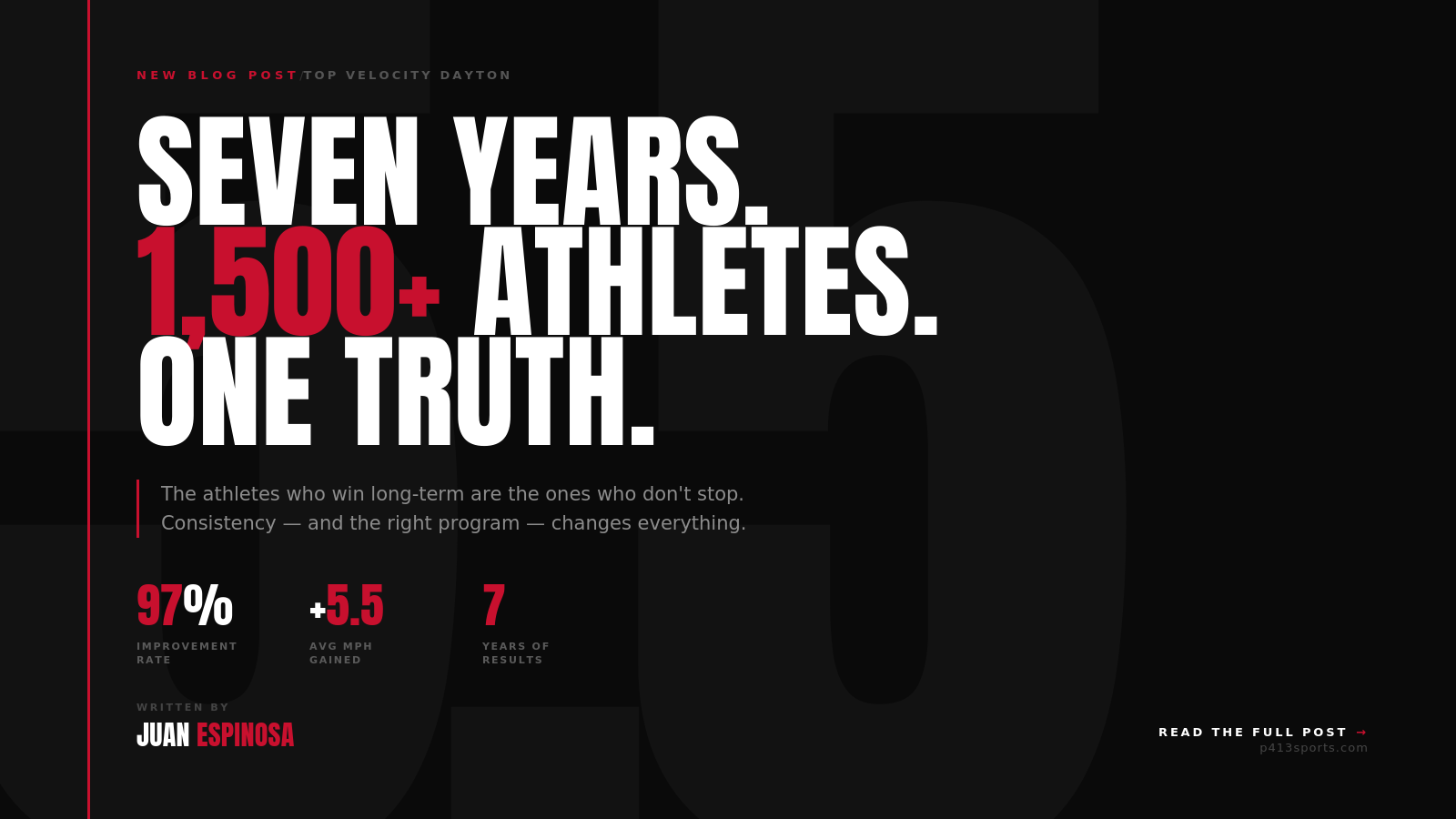
What 7 Years and 1,500+ Athletes Taught Me About Throwing Velocity
After seven years and 1,500+ athletes, one truth holds up: the ones who win long-term are the ones who don't stop. Here's what consistency — and the right program — actually changes.
If there's one thing I've learned after seven years of training baseball athletes in the Dayton area, it's this: the athletes who win long-term are the ones who don't stop.
That sounds simple. But most athletes don't do it.
The Consistency Gap Is Real
Baseball is a long season — especially when you're playing year-round. And the biggest mistake I see athletes make is treating their development the same way they treat their season: they go hard, then they stop.
Here's what that actually looks like in practice. An athlete trains with us through the winter, gains velocity, feels great going into spring. Then the season starts, training stops, and three to five months go by. By the time fall rolls around, they're right back where they started — sometimes worse.
Meanwhile, the athlete next to them who never stopped? They maintained. And when that next training window opens, they're building on top of last year's gains — not trying to catch up to them.
Over seven years and more than 1,500 athletes, I've seen this play out hundreds of times.
A Program Built to Scale With Your Athlete
Our program was originally designed for college athletes. What we've done over the years is learn how to take the core of that methodology and scale it intelligently — for a nine-year-old, a middle schooler, a high school freshman, or a college junior trying to add the final few miles per hour.
The framework is the same. The application is different.
And it's not just about age. Within any group, you'll have athletes at completely different ability levels. A college athlete who can't do a single pull-up is not on the same program as the guy next to him repping out sets with sixty pounds added. We meet every athlete where they actually are and push them from that point forward.
The Honest Conversation We Have With Every Family
One of the things we do early with every athlete is have a real conversation about goals and time commitment. If you want to reach a certain level, here's what it takes. If you can only train once or twice a week, we're not going to hand you a program that requires four sessions to work. That's not fair to you or your athlete.
That honesty is a big part of why we've retained athletes for four, five, six, even seven years — kids who started with us at ten years old and are now training with us in college.
What This Means for Your Athlete
Whether your son is a twelve-year-old multi-sport kid who wants to get better at pitching, or a high school junior chasing a college roster spot, the path forward is the same: consistency, an honest commitment level, and a program that grows with him.
That's what we've built at Top Velocity Dayton. And 1,500+ athletes later, the data backs it up.
Interested in what year-round development could look like for your athlete? Reach out at topvelocitydayton@p413sports.com or visit p413sports.com.